Beyond the headline: Making sense of Indonesia's GDP growth
Indonesia's unexpectedly strong growth raises a familiar question: how much can economic statistics tell us about conditions on the ground? Indonesia's economy…
Indonesia's unexpectedly strong growth raises a familiar question: how much can economic statistics tell us about conditions on the ground?
Indonesia's economy grew by 5.47% year on year in the third quarter of 2026, according to figures released by Statistics Indonesia (BPS) on November 5th. The result beat most economists' forecasts and should have offered reassurance about the economy's resilience. Yet it has also prompted questions about how growth is measured and what the figures reveal about underlying economic conditions.
One detail warrants attention. BPS marked its third-quarter growth figures with three asterisks (***), indicating that they remain highly provisional. The same designation appeared in the second quarter, but not in the first quarter of 2026 or throughout 2025. Provisional estimates are a normal part of national accounting, reflecting the gradual availability and refinement of economic data.
Of greater significance is the statistical discrepancy between GDP measured by production and by expenditure. In principle, the two should be identical. In practice, differences in data sources, coverage and timing can produce gaps. Such discrepancies are common in national accounts and do not, in themselves, imply that official growth figures are incorrect.
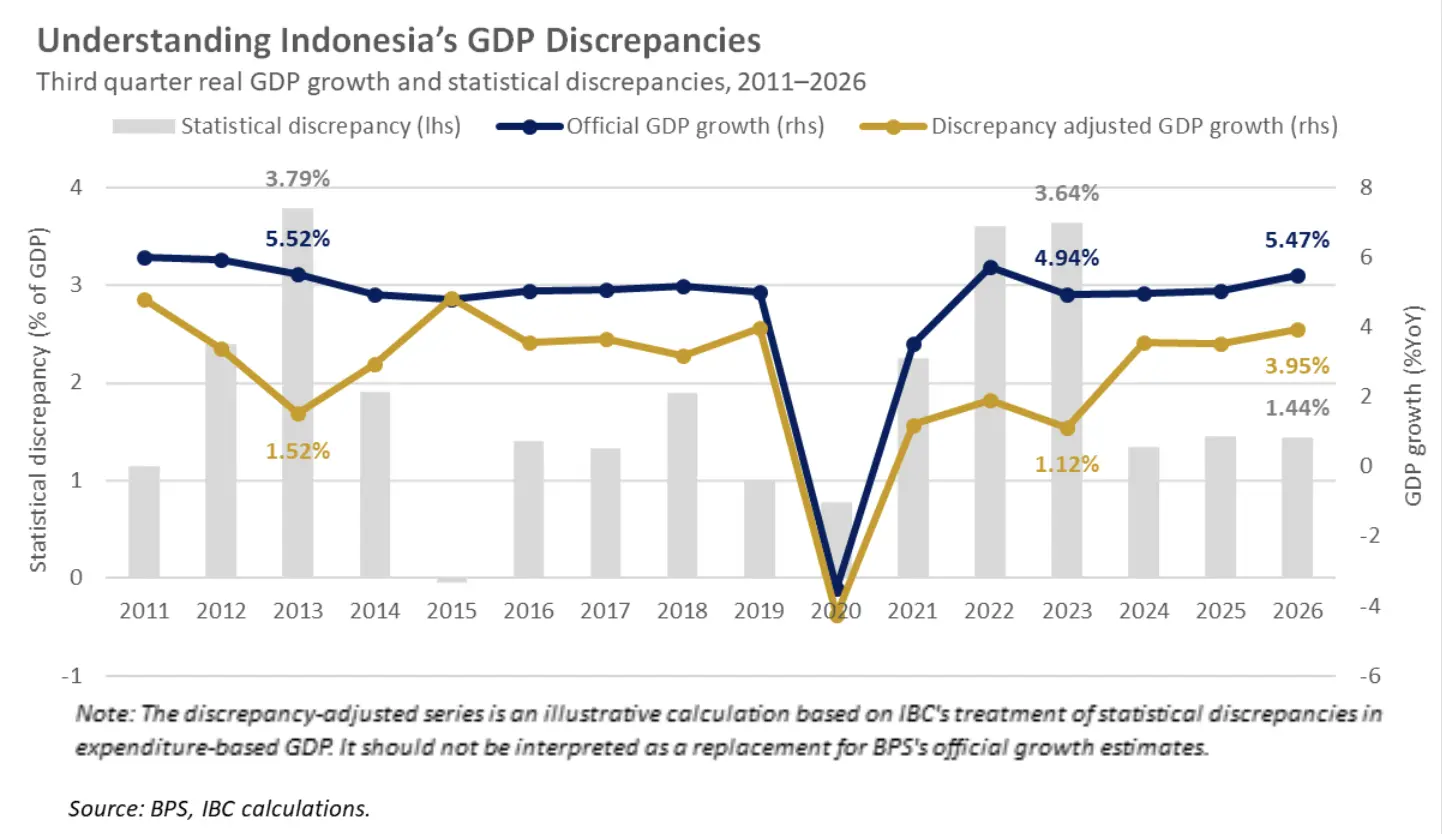
In the third quarter of 2026, Indonesia's statistical discrepancy reached Rp52.2trn at constant prices, equivalent to 1.44% of real GDP.
Incorporating this discrepancy into the expenditure-based GDP series yields an illustrative growth rate of approximately 3.95%, rather than the official 5.47%. This is not a competing estimate of actual growth. Nor does it invalidate BPS's figure. It does, however, show how differences in accounting can materially affect interpretations of economic performance.
"The distinction matters because economic policy must respond to conditions on the ground," says Denni Purbasari, IBC's Chief Economist. "A narrow range of estimates may lead to broadly similar assessments. A wider divergence calls for greater caution in interpreting the data and designing policy responses."
Such discrepancies are not unprecedented. In the third quarters of 2013 and 2023, they were larger still, reaching 3.79% and 3.64% of real GDP, respectively. Their recurrence highlights the importance of continuously improving data collection, measurement and reconciliation.
Why does this matter beyond the growth headline?
GDP is not merely a measure of economic activity. It also provides the denominator for indicators used to assess fiscal sustainability, investment, productivity and other aspects of economic performance. Uncertainty about its measurement can therefore complicate decisions far beyond the interpretation of a single quarterly release.
"Better data lead to better decisions. When statistics fail to reflect economic realities, even well-intentioned policies can produce the wrong outcomes. Statistical accuracy is not merely a technical matter; it is an economic imperative," says Denni.
BPS plays an indispensable role in providing the information on which governments, businesses and investors rely. Strengthening the quality of its data, improving reconciliation and communicating statistical limitations transparently would reinforce confidence in Indonesia's economic statistics.
The third quarter's encouraging growth deserves recognition. But understanding what the numbers reveal, and what remains uncertain, is equally important.
Better economic decisions begin with better economic data. Their quality, transparency and credibility are a shared national interest.