
Beyond Inflation, Rising Food Prices Put Further Strain on Indonesia’s Economy
Food prices remain Indonesians' foremost economic concern. Poltracking's August survey found 44.3% of respondents identifying expensive basic necessities as…
Food prices remain Indonesians' foremost economic concern. Poltracking's August survey found 44.3% of respondents identifying expensive basic necessities as the country's most pressing problem. SMRC's October survey reached a similar conclusion.
The concern is justified. September's volatile food inflation accelerated to 5.03% year-on-year, from 4.06% in August, well above headline inflation of 3.28%. Rising production costs and supply disruptions—from restrictive trade policies and El Niño to fuel shortages and power outages—may partly explain the increase.
Whether fiscal expansion is adding inflationary pressure, on top of rising food demand from the Free Nutritious Meals (MBG) programme, remains unclear. By September 22, Bank Indonesia held Rp1,931 trillion in government securities, or 27.82% of outstanding tradable rupiah-denominated government debt, up nearly Rp400 trillion, or 24%, year-on-year. While BI's purchases inject liquidity, its issuance of Rupiah Securities (SRBI) absorbs it. The net inflationary impact remains uncertain.
The consequences deserve attention. First, poverty could rise. Food accounted for 74.7% of Indonesia's poverty line in March 2026, compared with just 28% for food, beverages and tobacco in the consumer price index. Higher food prices threaten recent poverty reductions. Second, purchasing power could weaken. More spending on necessities leaves less for discretionary purchases. Capital-market turbulence could make even wealthier households more cautious. Vulnerability is particularly pronounced in Pandeglang and Lebak, where food, beverages and tobacco account for 45.7% and 42.5% of consumer price baskets, respectively.
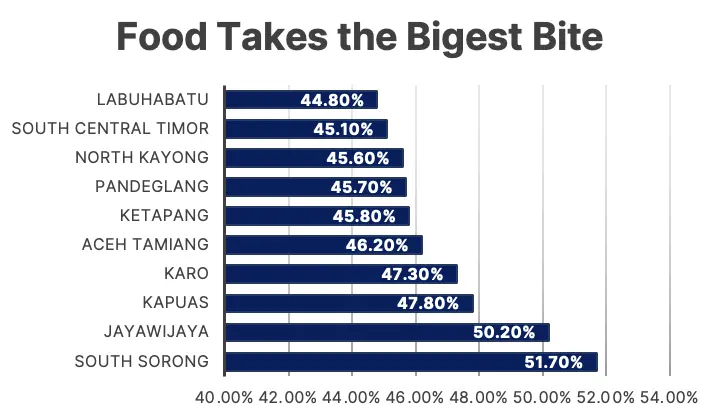
Source: BPS, Diagram Timbang Indeks Harga Konsumen Hasil Survey Biaya Hidup 2022
Third, business margins could narrow. Rising input costs and weak purchasing power limit pricing flexibility. BI's latest business survey shows slowing activity despite improving aggregate profitability, potentially masking pressures on smaller firms.
These risks call for policies that expand supply rather than constrain it.
"The government should ease restrictive and distortionary trade policies that constrain food supplies and drive up prices. Protecting domestic producers should not come at the expense of consumers, particularly poorer households that spend much of their income on food," said Chief Economist IBC Denni Purbasari.
Headline inflation remains within BI's target. But price stability means little if food becomes increasingly unaffordable.