With the ASEAN Summit and ASEAN-Indo-Pacific Forum Momentum, the Indonesian Business Council (IBC) Pushing for Competitive and Business-Friendly Policies
The Indonesian Business Council (IBC) welcomes the outcomes of the 2026 Indonesia–Singapore Leaders' Retreat, held in Jakarta on 6 July 2026, as a positive…
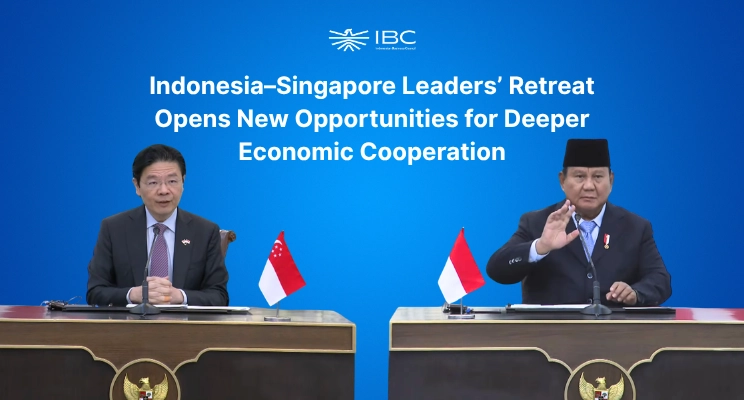
The Indonesian Business Council (IBC) welcomes the outcomes of the 2026 Indonesia–Singapore Leaders' Retreat, held in Jakarta on 6 July 2026, as a positive step in deepening economic ties between two of Southeast Asia's most closely connected economies. The retreat between President Prabowo Subianto and Singapore Prime Minister Lawrence Wong produced 26 outcomes across government and business cooperation.
The agreements made at the retreat, covering supply chain resilience, cross-border electricity trade, investment, digital cooperation, environmental collaboration, and human capital development, reflect the growing breadth of the bilateral relationship. These areas are increasingly important for businesses facing a more fragmented global economy, rising pressure on supply chains, rapid technological change, and the need for more secure and affordable energy.
“Indonesia and Singapore already have a strong economic relationship. The next opportunity is to connect our respective strengths more effectively, particularly in areas such as energy, industrial development, technology, and investment. For businesses, the real test will be how these agreements are implemented. Close collaboration between government and the private sector will be important to translate them into clearer frameworks, more efficient processes, and greater certainty for long-term investment,” said VP International Affairs and Operations IBC, Noto Suoneto.
IBC sees significant room for the two countries to build on their complementary strengths. Indonesia offers market scale, industrial capacity, resources, and growing energy needs, while Singapore brings capital, technology, global connectivity, and international investment networks.
Effective implementation will now be critical. Stronger coordination between governments and the private sector can help turn bilateral commitments into sustained investment, more resilient supply chains, and a stronger foundation for Southeast Asia’s competitiveness.