
Policy Certainty for Sustainable Growth, IBC Highlights Role of Business Evidence
As businesses navigate geopolitical uncertainty, supply chain shifts, and increasingly complex regulations, policy engagement is becoming central to how…
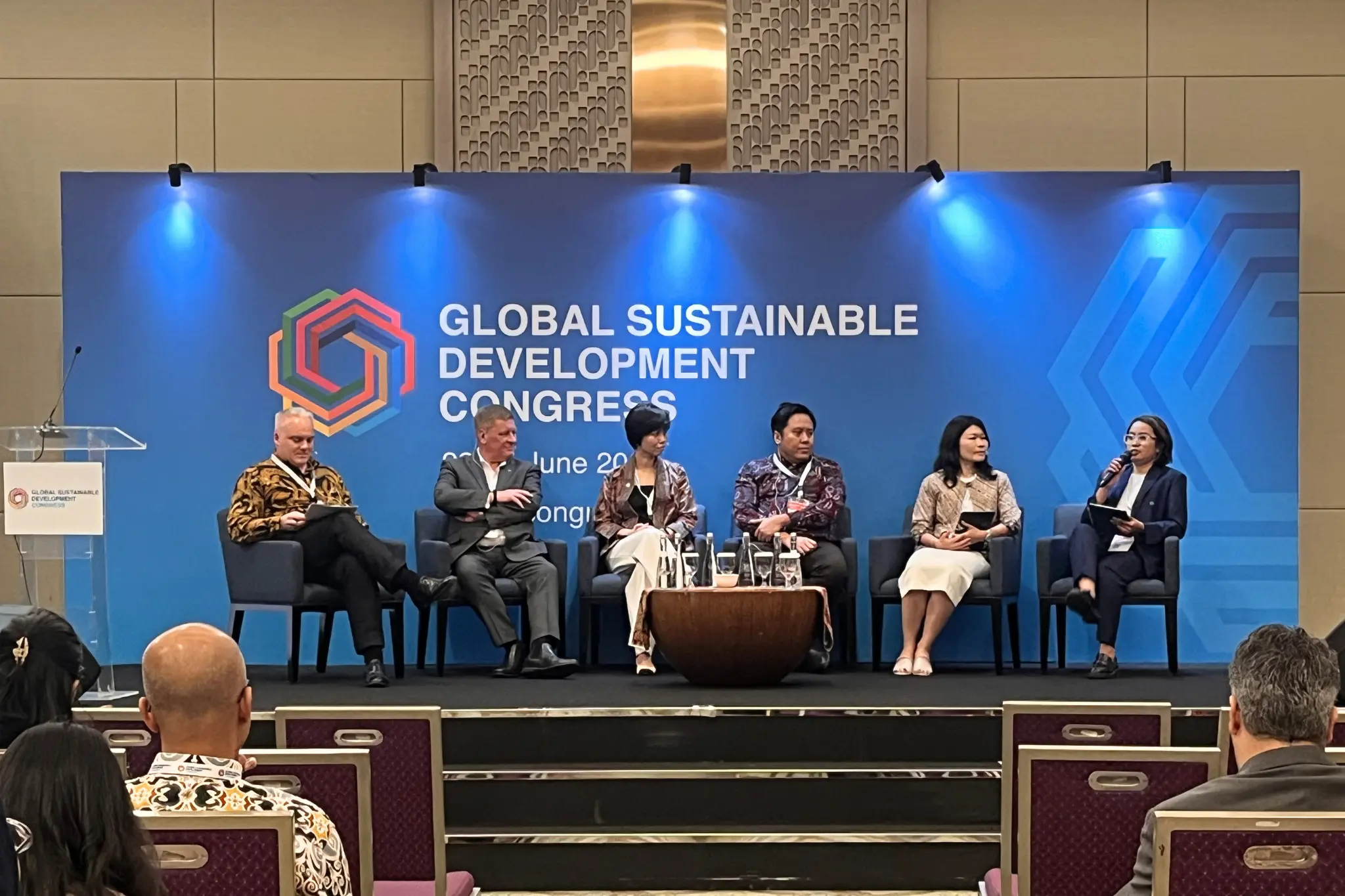
As businesses navigate geopolitical uncertainty, supply chain shifts, and increasingly complex regulations, policy engagement is becoming central to how companies support sustainable growth. This issue was discussed during the panel “Corporate Affairs and Policy Engagement in Sustainable Growth” at the Global Sustainable Development Congress 2026 on 23 June 2026, featuring perspectives from business associations, multinational companies, and regional stakeholders.
Principal Policy and Program IBC Karlina Aucia Agusta joined the discussion to share an Indonesian business perspective. She noted that Indonesia remains fundamentally attractive as an investment destination, but long-term investment decisions increasingly depend on whether companies can trust that regulations will be clear, consistent, and supportive over a 10 to 20-year horizon.
She emphasised that policy credibility, transparency, and predictability now directly shape how capital is priced and allocated. Regulatory changes can no longer be viewed solely as government relations matters. Changes in policy direction or implementation can immediately influence capital expenditure, supply-chain configuration, supplier preparedness, and investor confidence. “We don’t need more ceremonies. We need a system that turns business evidence into better policy,” Karlina said.
The discussion also brought forward IBC’s 3C framework: certainty, capability, and capital, as a practical lens for sustainable growth. Certainty means businesses understand the rules and can trust how they will be applied. Capability refers to the readiness of institutions, firms, workers, and suppliers to execute. Capital ensures that long-term finance can move into productive sectors that create broader economic value.
In the context of sustainability, the panel underlined that business contributions should go beyond investment commitments. Companies can play a stronger role by building capability rather than dependency, supporting technology transfer through people and skills, and helping smaller suppliers meet higher standards to access broader markets.
The session concluded that sustainable growth requires more practical and evidence-based public-private dialogue. Business associations can help bridge the gap between policy intent and implementation by consolidating private-sector input, identifying operational challenges, and translating them into clear policy evidence to support better execution.