IBC Urges Indonesian Firms to Become Regional Ecosystem Builders
Indonesia’s opportunity to become a stronger contributor to ASEAN’s industrial and manufacturing ecosystem will depend on whether investment creates deeper…
Indonesia’s opportunity to become a stronger contributor to ASEAN’s industrial and manufacturing ecosystem will depend on whether investment creates deeper capabilities, stronger suppliers, better jobs, and greater regional integration.
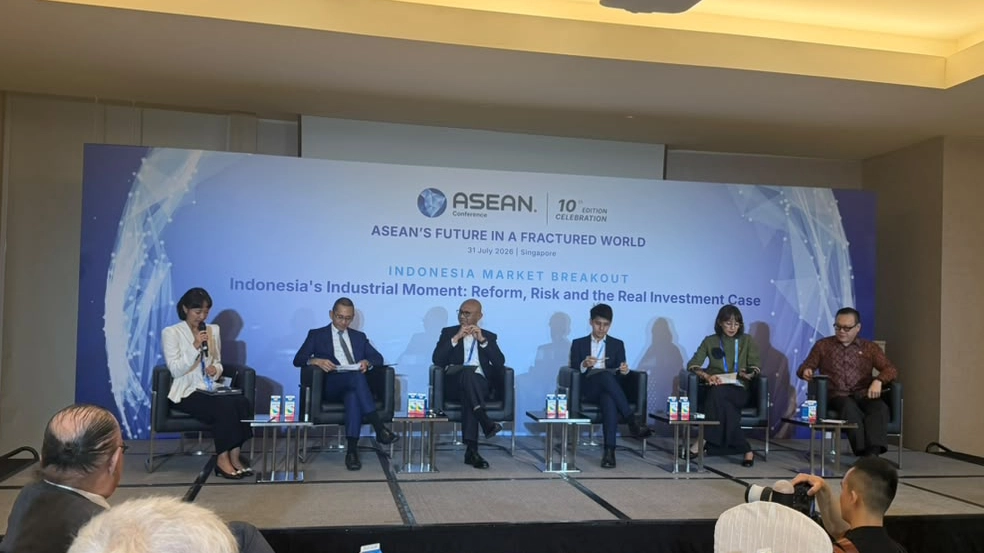
At the ASEAN Conference 2026 in Singapore on the 31st of July 2026, COO IBC William Sabandar joined the panel “Indonesia’s Industrial Moment: Reform, Risk and the Real Investment Case.” He argued that Indonesia’s leading companies must move beyond expanding production and become ecosystem builders that connect investors, domestic suppliers, workers, universities, infrastructure providers, and regional partners.
This requires businesses to invest in engineering, components, product development, advanced manufacturing, industrial services, and technology. Large companies must also bring SMEs and local enterprises into their supply chains through long-term procurement, financing, technology transfer, quality certification, and management support. The objective should not only be to increase domestic sourcing, but to help Indonesian suppliers become more productive and capable of competing in export markets.
William also highlighted the importance of an ASEAN production strategy. Rather than attempting to manufacture everything domestically, Indonesia should identify its comparative advantages and connect them with the strengths of Singapore and other ASEAN economies. Indonesia can provide industrial scale, land, talent, energy potential, and access to a major market, while Singapore contributes finance, research, technology, headquarters functions, and global connectivity.
This proposition is central to the joint policy study undertaken by IBC, the Singapore Business Federation, and Deloitte on strengthening Singapore–Indonesia collaboration through Special Economic Zones, particularly in Batam, Bintan, and Karimun (BBK).
BBK could support two major innovation ecosystems. The first is a green industrial ecosystem combining efficient ports, low-emission logistics, renewable energy, circular water and waste systems, and low-carbon industrial parks. The second is a digital and artificial intelligence ecosystem covering data centres, cloud infrastructure, cybersecurity, digital manufacturing, software engineering, and applied research.
For these opportunities to materialise, Indonesia must close the gap between policy intention and operational delivery. William identified execution certainty as the country’s most important competitiveness requirement. Investors need to know that projects can move from decision to operation on time, at a known cost, and under stable rules.
IBC has proposed a 90-day investor fast track supported by a transparent checklist, fixed processing timelines, digital tracking, and clear escalation channels. A regulatory and delivery sandbox in Batam could also test reforms before successful approaches are replicated nationally. IBC will continue bringing business experience into policymaking and translating investor concerns into actionable recommendations. Indonesia’s industrial progress should ultimately be measured not by how much land its economic zones occupy, but by the innovation, capabilities, exports, and long-term value they create.