
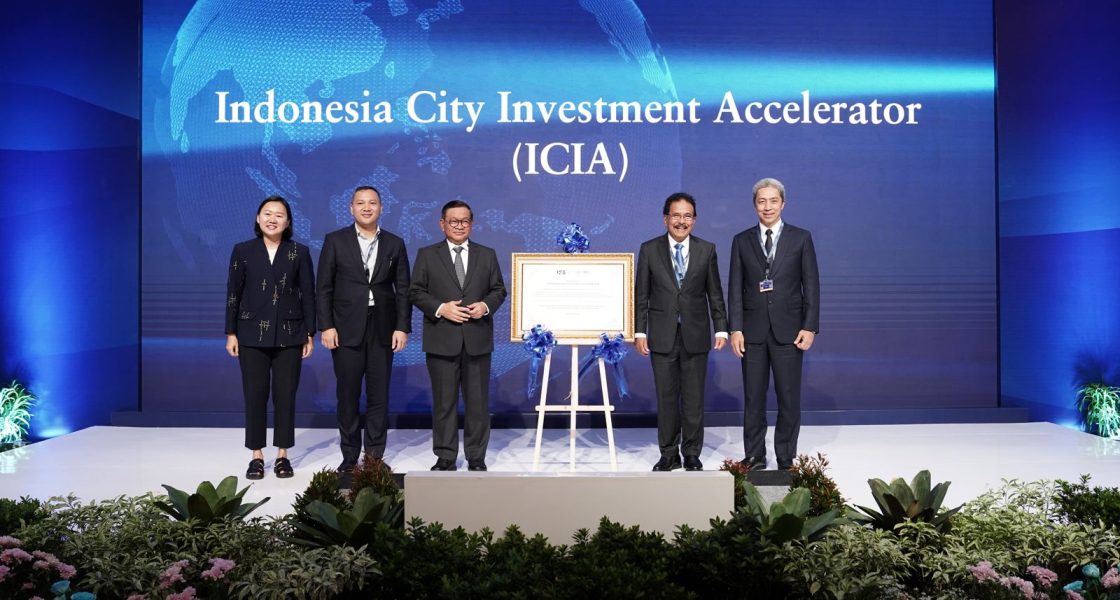
Jakarta, February 3, 2026 — Indonesia City Investment Accelerator (ICIA) officially launched in the Indonesia Economic Summit (IES) 2026 to accelerate the city’s investment readiness. The urgency of this initiative is clear: a UN report by the end of 2025 recorded that the Jakarta Urban Area and its surroundings had become the most populous urban area in the world with nearly 42 million residents, overtaking Tokyo, reflecting the rapid growth of other cities in Indonesia and the increasing need for urban investment nationally. Indonesian cities face serious limitations in investment financing. Regional budgets are still dominated by central transfers, accounting for 70–80% of the budget, which are tied to the budget. Locally generated revenues generally account for less than 10%, almost entirely used for operational expenses. Furthermore, while regional loans and bonds are legally possible, their implementation is hampered by multiple approval requirements, strict debt limits, and a weak regional asset base to support financing. These fiscal constraints are exacerbated by low project readiness and technical capacity at the city level. Many projects lack adequate financing structures, risk assessments, and institutional readiness, making it difficult to attract investment despite the availability of capital demand and interest. In this context, the Indonesia City Investment Accelerator (ICIA) is needed as a lever to strengthen project readiness and open more credible urban investment pathways. Governor of DKI Jakarta, Pramono Anung, who also witnessed the launch of ICIA, said Jakarta’s economic growth reflects not only numbers, but also resilience. Maintaining competitiveness amidst flooding, congestion, and urban pressures requires strong governance and constant coordination. This is the reality of managing a global city. Chief Operating Officer of the Indonesian Business Council and one of the initiators of the Indonesia City Investment Accelerator (ICIA), William P. Sabandar, emphasized that the main challenge for urban investment lies in execution. He noted that Indonesia has no shortage of plans or capital, and cities generally know what they want to build. However, many priority projects remain stuck between the planning, approval, and financing stages, preventing them from becoming truly investment-ready. As part of the Indonesia Economic Summit (IES) 2026, the Indonesia City Investment Accelerator (ICIA) was officially launched by the initiators, including Bambang Susantono, Dean of the Cities and Local Governments Institute (CLGI) Asia-Pacific; Rachmat Kaimuddin, Deputy for Basic Infrastructure Coordination of the Coordinating Ministry for Infrastructure and Regional Development; Sofyan Djalil, Chief Executive Officer of the Indonesian Business Council; William Sabandar, Chief Operating Officer of the Indonesian Business Council; and Silvia Halim, Deputy for Infrastructure and Facilities of the Indonesian Capital City Authority for the 2023–2024 period. The launch of ICIA was also witnessed by the Governor of DKI Jakarta, Pramono Anung, and the Mayor of Bogor, Dedie A. Rachim. The ICIA will serve as a platform that brings together governments, the private sector, investors, financing institutions, and other urban stakeholders, as part of a shared commitment to strengthening urban investment readiness through cross-perspective collaboration. The launch of the ICIA at IES 2026 marks a starting point for strengthening the urban investment ecosystem and marks a shift in focus from planning to concrete action in addressing the challenges of sustainable urban investment.
