

Jakarta, February 4, 2026— Amid the need to strengthen financial markets and long-term financing, Islamic sustainable finance is increasingly seen as an important driver of inclusive and sustainable economic growth in Indonesia. The issue is in focus in the Roundtable Discussion on Islamic Sustainable Finance for Deepening Markets and Advancing Inclusive Growth, which is held at the Indonesian Business Council (IBC) together with the Global Ethical Finance Initiative (GEFI) in the Indonesia Economic Summit (IES) 2026.
This discussion confirmed that Islamic finance is no longer an add-on to the national financial system. With consistent asset growth and strong support from the real sector, Islamic finance has significant potential to deepen financial markets, expand long-term financing, and strengthen investor confidence, particularly in capital markets.
Numerous data demonstrate this momentum. In the real economy, the halal sector, spanning food and beverages, Muslim fashion, Muslim-friendly tourism, and halal agriculture, accounted for approximately 25% of the national Gross Domestic Product (GDP) by 2024. The government targets an increase in this contribution to the sharia economy to more than 56% by 2029, in line with strengthening the ecosystem and deepening the sharia financial market.
In the opening remarks, Chief Operating Officer IBC William Sabandar stated that the challenge ahead is not only to maintain the growth rate but also to ensure that Islamic finance truly has a real impact on the real economy and long-term development.
“Amidst the need for stability and trust in financial markets, Islamic sustainable finance offers added value based on ethical principles, transparency, and accountability. With a robust ecosystem, diverse instruments, and credible standards, sustainable Islamic finance can help deepen financial markets while supporting the green transition and inclusive growth,” said William.
As an organization representing national business actors, IBC positions itself as a strategic liaison among the government, regulators, market players, and international partners. Through the Economy and Financial Development pillars, IBC actively promotes data-driven dialogue, strengthens market confidence, and mobilizes long-term investment, including by developing Islamic and sustainable finance.
From a global perspective, as Chair of the Global Ethical Finance Initiative, Dame Susan Rice, Indonesia is strategically positioned to become a benchmark for the development of Islamic sustainable finance in the region and across developing countries. The alignment of Islamic finance principles with the ESG framework is seen as opening significant opportunities for Indonesia to attract global capital, provided it is supported by consistent policies, market innovation, and cross-stakeholder collaboration.
This roundtable discussed key issues, including deepening the Islamic capital market, developing green and sustainability-compliant sharia-compliant instruments, leveraging blended Islamic finance to reduce early-stage project risks, and the role of Islamic insurance in strengthening risk management and investor confidence.
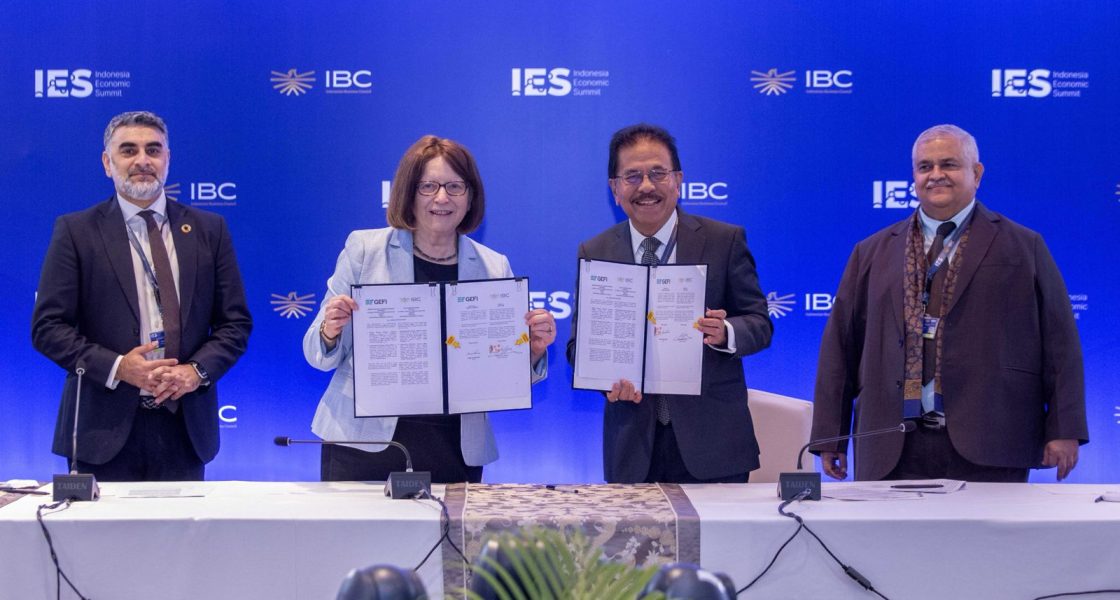
As part of the series of activities, IBC and GEFI also signed a Memorandum of Understanding (MoU) as the initial step toward strategic collaboration in Islamic, ethical, and sustainable finance. This collaboration includes policy dialogue, knowledge exchange, and the development of future joint initiatives.
Through this collaboration, IES 2026 is expected to be a momentum to strengthen Indonesia’s position in the ecosystem. Islamic sustainable finance, regional and global, while simultaneously encouraging the formation of a deeper, more resilient, and more inclusive national financial system.