
Higher Fed Rates, Narrower Policy Space
The U.S. Federal Reserve’s latest rate hike could leave Indonesia facing a difficult policy trade-off: defending the rupiah while trying to deliver the…

The U.S. Federal Reserve’s latest rate hike could leave Indonesia facing a difficult policy trade-off: defending the rupiah while trying to deliver the government’s 5.4% growth target this year.
The Fed raised its benchmark rate by 25 basis points on Sept. 16 to 3.75–4.00%, a move that was largely expected as the central bank sought to contain persistent inflation. But with inflation still elevated, another increase this year now appears increasingly likely.
The prospect of another Fed increase before year-end comes at a particularly difficult time for U.S. bond markets. Federal debt is high, and the Treasury market has been under strain. The 10-year Treasury yield moved above 5% ahead of the Fed’s latest decision. Further rate hikes could reinforce upward pressure on Treasury yields and trigger a broader repricing across global financial markets.
For Indonesia, higher U.S. interest rates could affect capital flows, the rupiah, borrowing costs and the fiscal burden. Denni Purbasari, chief economist at the Indonesian Business Council, said, “The bigger question is whether other central banks will also raise interest rates, pushing up the global cost of capital and potentially triggering a broader wave of deleveraging.”
Signs of pressure are already visible. Between the Fed’s previous policy announcement on July 29 and its latest decision on Sept. 16, the yield differential between Indonesian and U.S. 10-year government bonds narrowed by about 50 basis points, from 266 to 216. The rupiah, meanwhile, had weakened by about 6.76% against the dollar since the beginning of the year. The Bank of Japan’s decision today to raise its policy rate adds another source of global monetary tightening.
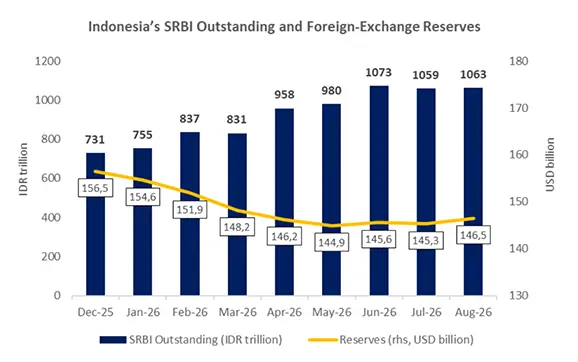
Bank Indonesia has been using both monetary instruments and foreign-exchange intervention to support the rupiah. Yields on its rupiah securities, known as SRBI, have approached 7% for the 12-month tenor. Between end-2025 and August 2026, total SRBI outstanding rose 45.4% to Rp1,062.9 trillion (~$60 billion), while foreign-exchange reserves fell by about $10 billion to $146.5 billion.
Continued pressure on the rupiah could add to inflation through higher import costs, compounding pressures from oil prices and El Niño. If those pressures intensify, Bank Indonesia may have to raise its policy rate.
The strain would not stop at the central bank. The government could also face higher energy and fertilizer subsidy costs, while persistently high yields would gradually raise the cost of issuing and refinancing government debt. At the same time, the government must keep the budget deficit below the statutory ceiling of 3% of GDP. That could leave less room for other government spending and make budget reallocations increasingly difficult to avoid.
The result is less room for both monetary and fiscal policy to support growth. Against this increasingly challenging global and domestic backdrop, the 6% growth assumption underpinning the 2027 state budget appears increasingly ambitious.
“A realistic and credible growth assumption is critical because it underpins the government’s revenue projections, spending plans and overall fiscal framework,” Denni concluded.